Never Assume: The Key Difference Between Speaking and Writing
February 6, 2026 | By David Allen, Ph.D.
As an academic copy editor, I work on writing from highly intelligent clients. Often, that writing is difficult to understand. This is because many writers do not understand that requirements of spoken English and written English are quite different. So, let me take a moment to explain how spoken and written English differ and how non-native English speakers compound the problem.
Why We Communicate
Language is a way we encode our thoughts in words to make them transferable to another person. To transmit those words, we rely on speaking and writing. However, when we speak in-person to someone (and even to our pets) we use more than spoken words. We use a rich mélange of sounds and gestures to help ensure our message is accurately and understandable delivered. In communication theory, verbal, non-verbal, and hyper-verbal message transmitters are known as channels.

Language's purpose is to transfer ideas from one person's mind to another's.
Speaking and writing are ways we transmit languages between people. However, when we speak, the transmission of an idea takes place using more than the words spoken. Interpersonal speaking involves a rich mélange of sounds and gestures without which messages lack clarity. In communication theory, verbal, non-verbal, and hyper-verbal message transmitters are known as channels.
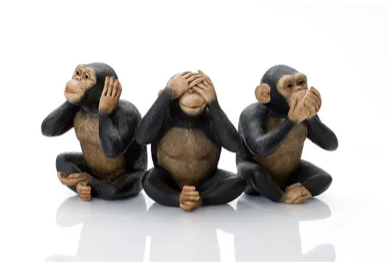
For example, when communicating in-person, a speaker's use of non-verbal, vocal cues found in the dynamics of tone, pitch, and speed, emphasizes and clarifies meaning. These non-verbal, vocal cues are called vocalics. In addition, hand and facial gestures, eye contact—or lack thereof—that help deliver our message are known as body language. These cues are called gestus, the embodiment of an attitude. The more channels one uses to communicate, the more likely the receiver will properly understand the message. Conversely, the fewer channels used, the less likely understanding will occur.
Think about the richness of communication in various settings. Would you rather communicate in-person where many channels come into play or through telephonic contact in which all visual cues are lost? Or would you rather communicate through the written word in which all aural and visual channels vanish, leaving only the written word. Each of these step-downs reduces the number of channels and increases the need for greater clarity. Therefore, when writing it is imperative that the message's meaning is made abundantly clear.
Writer's Assumptions
Unfortunately, many writers assume that putting words onto a two-dimensional medium—paper, text message, writing app, etc.—just as they would as if speaking is sufficient to clearly transmit their message. But without using those other channels to help clarify meaning, that meaning is often lost.

Take the simple sentence, "I love you." In speech, there are a thousand ways to say it.
The application of vocalics and gestus help distinguish between meaning "I adore you more than I can put into words" and "I don't really mean this because I hate your guts." Without those additional channels that clarify, the true meaning is lost.
Now, imagine longer, more complicated pieces of communication. For example, this sentence from a real paper:
Thank you about what you wrote, I am calm and crossing my fingers as the adverse of my case is considering the application incomplete one, and all of our work will dismissed [sic].
The grammar (elements of punctuation, capitalization, etc.), syntax (the arrangement of the words in a cohesive sentence), missing verbs, and poor word choice cause major problems. When spoken in-person, vocalics and gestus would help the auditor—the person listening and watching the speaker—understand the message. But in writing only, a reader will have difficulty understanding the message.
The lesson here is that writers cannot get away with the same errors as speakers can. They must be far more careful when constructing written work. They must keep the reader in mind at all times. To do so, they must never assume that every reader will already understands all the concepts and jargon with which they and many of their peers take for granted as being understood.
Advice
When I write, I choose a reader to whom I am writing. That reader has always been my mother.

She was a very intelligent woman with a college education who did the New York Times crossword puzzle in ink. Yet she knew practically nothing about the subjects I write about. So, I make sure that all complicated ideas and jargon are explained. That doesn't mean that I dumbed down the writing. It means that I use language understandable to the average college graduate (unless I am specifically writing for a wider audience who may be less educated audience such as an article in a travel magazine).
So, if you want to ensure your written message gets across clearly and fully, choose your reader—someone you know well—and write as if you are directing your thoughts directly at them, and do so in a way in which they will understand.
Need Help Ensuring Your Message is Clear?
Let me help you bridge the gap between speaking and writing.
Get in Touch