Ways to Write Good Well
February 8, 2026 | By David Allen, Ph.D.
"To err is human…" - Alexander Pope
"Love is blind, and lovers cannot see/The pretty follies that they themselves commit." – William Shakespeare, The Merchant of Venice
"…Lend me your ear." - William Shakespeare, Julius Caesar
Alexander Pope hit the proverbial nail on the head—humans are prone to making mistrakes (sic). So are AIs, by the way, even those writers use to catch their typos, punctuation errors, poor sentence construction and misaligned structure. My job as an editor is to find and repair those the writer failed to catch, but the time it takes to ferret out those mistakes—and therefore the increased cost of editing—can be reduced if writers use a few simple tricks to catch their own goofs.
Carnegie Hall
There is an old joke about the famous New York City concert venue, Carnegie Hall.

A lost visitor lost on their way to a concert sees a passerby carrying a violin case. Assuming a musician would know how to get to the venue, the visitor asks, "Can you tell me how to get to Carnegie Hall?"
The musician looks down at their violin case, sighs, and replies, "Practice, practice, practice."
Though the stranger remains lost, they do understand that If you want to get to the highest level of your art, you must practice, practice, and practice some more. After all, they say that practicing for 10,000 hours will make anyone an expert at anything.
So, to reduce your errors in the first place, become a better writer by improving your skills The best way to get there is to follow that musician's advice – practice, practice, practice. The more you write, generally, the better you will get.
The "Time Out" Method

One of the simplest ways to improve your writing by taking a "Time Out."
In the good old days before computers, taking a writing "Time Out" meant putting your hand-written draft in a desk drawer for a few days. Then, retrieve and read it. Suddenly, all the brilliant writing you thought you'd accomplished, didn't look so good. You would wonder:
"What did I mean by that word?"
"Why is that paragraph there when it belongs up here?
"Why doesn't that sentence make sense?"
"How could I possibly have misspelled my own name?"
As Shakespeare pointed out, we become enamored of our writing. We assume that we said exactly what we were thinking. Yet, for most of us, what winds up on the paper does not exactly mean what we intended to mean. By taking a Time Out, we let the writing and our jubilation over it to fade from memory. Without love blinding us, we see the draft anew and more objectively, as if someone else had written it.
Of course, today, you don't put the draft in a drawer. You just leave on it your computer desktop or in an easy to find file for a few days. The result is the same. In fact, I just let the last two paragraphs sit for a few days and came back to them. I found typos, grammatical errors and better, found ways to make the language more concise which also made my meaning clearer.
Time Out works!
"Phone" a Friend
The internationally successful television game show, "Who Wants to be a Millionaire?" lets contestants to place a phone call to a friend who might help answer a question. Writers, especially non-native English writers, should do the same.

For example, before I post this blog, I will ask several friends who understand the field (in this case, writing) to review it. They will catch typos and grammatical errors neither I nor my grammar/spelling checker caught and let me know what in the writing works and what doesn't.
Based on their response, my writing improves.
A note to anyone writing in a foreign language:
Find someone fluent in speaking and writing the language you are writing. "Phone" someone who can catch the problems found when the grammar, punctuation and syntax of one language is applied to another (See Writing in a Foreign Language). If you don't know anyone with enough fluency, hire an editor who is a native speaker of that language to review your writing before submitting it.
Read Aloud
Before I explain this method, I offer a short lesson in the use of quotation marks…
Look back at the heading of the previous section to notice that I placed quotation marks around the word phone. I did that because I did not want to suggest then that you actually place a telephone call to your friend (though asking a friend for help might entail a call) as they did on the game show. By placing the word in quotation marks, I indicated that it is a metaphor not to be taken literally. For this section, however, a telephone call just might do.
In this version of Phone a Friend, I do literally mean to place the call, unless the friend is already physically present. Once you have them by the ear, so to speak, read the document to them aloud. Doing so serves multiple purposes.

Reading it aloud forces you to look at each word before you pronounce it and then pronounce it. Those two views will usually alert you to typos, missed words and punctuation, and misused words. For example, you might have written there when you mean their or read instead of red.
Reading aloud, to others or yourself, will give you a better sense of sentences meaning and structure flow. For example, you might realize that this sentence is hard to understand and is missing a verb:
Thank you about what you wrote, I am calm and crossing my fingers as the adverse of my case is considering the application incomplete one, and all of our work will dismissed.
You might also realize that a definition that appears in the fifth paragraph would make better sense in the first.
Less is More
Many people are fans of 19th century writers such as Jane Austen or Charles Dickens. As a writer in the 21st century, I am not one of those. My disfavor is not about the plots or characters. It is about the long-winded narrative writing that is the antithesis of contemporary literature.
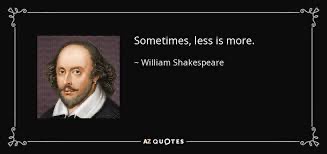
Today, in general, we agree with Mr. Shakespeare: less is more.
Once, I wrote what I though was a wonderful 2,000-word story only to receive feedback from my professor that said, "Rewrite this using half as many words." I did so and found that the story vastly improved. This was because, as discussed in my blog post, Never Assume: The Key Difference Between Speaking and Writing, I originally wrote as if I were speaking, using flourishes and empty phrases that, when accompanied by body language and vocalics, made my meaning clear. By deleting 50% of the words, I cut all these unnecessary flourishes, making the meaning of my written word clearer for the reader.
P.S.
My apologies for all the Shakespeare. I was a theatre professor after all.
Need Help Polishing Your Writing?
Let me help you catch those errors and improve your work before submission.
Get in Touch